


OGS-Drop
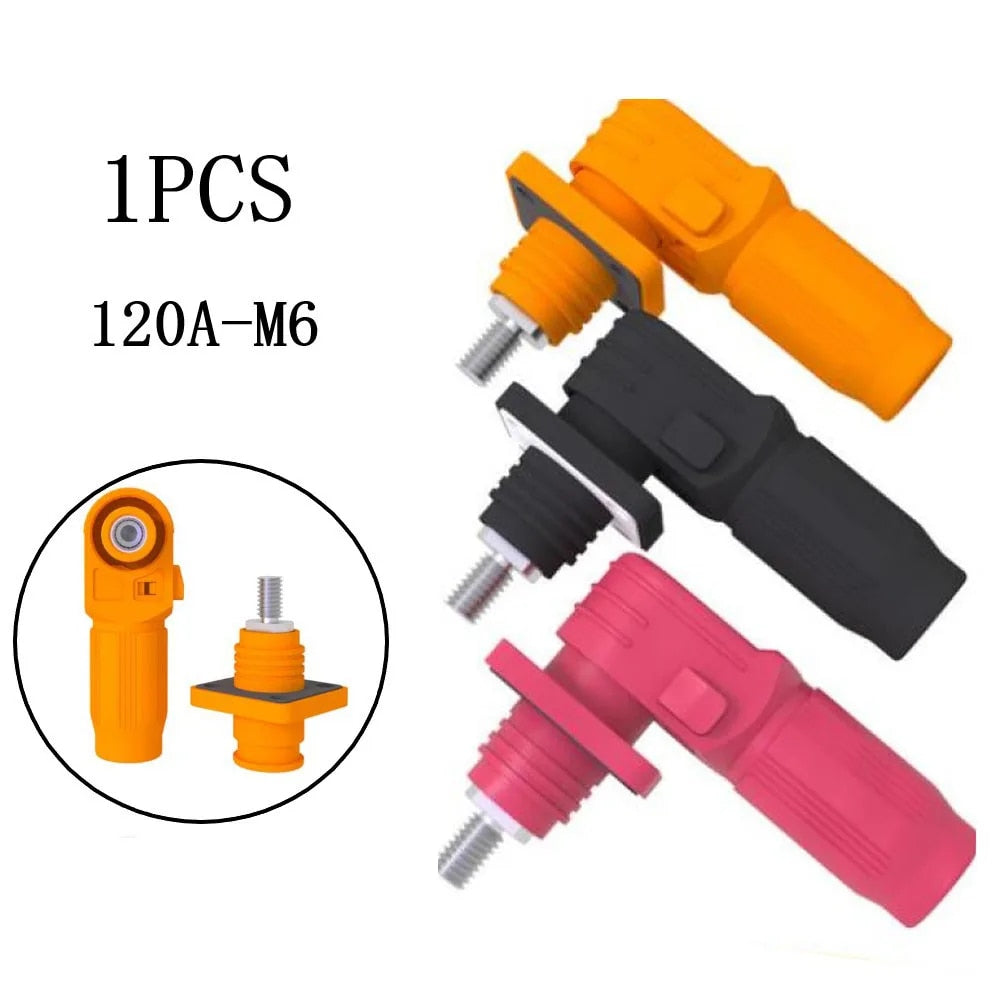
Battery Quick Disconnect Connector, 120A / 200A, IP67 Panel Mount
Battery Quick Disconnect Connector, 120A / 200A, IP67 Panel Mount
5 in stock
Couldn't load pickup availability
- Ships from Michigan
- Specs we measured
Most popular build: two 200A kits, one black and one orange.
Each kit is one panel-mount receptacle plus one cable plug, which covers a single conductor. A complete battery needs two kits, one for positive and one for negative. Color code them so you cannot cross them up in the dark.
Pair them with a 10 ton lug crimper for the ring terminals and a Class T fuse on the positive leg.
At a Glance
- Threaded stud terminal. Bolt a standard ring lug straight to the receptacle. No proprietary hardware.
- Two sizes. 120A on 4 AWG (25 mm²) with an M6 stud, or 200A on 1 AWG (50 mm²) with an M8 stud.
- Crown spring contact. Silver plated pure copper, under 0.5 mΩ contact resistance, no compression lug or torque tool needed on the plug side.
- Press to release. One key side press disconnect, and the plug rotates a full 360 degrees for clean cable routing in a tight box.
- IP67 sealed, IP2X finger safe when unmated. Rated -40°C to 125°C, 500 mating cycles.
- Sold individually. Order two per battery.
What You Need With It

REQUIRED
A connector is not protection. Every lithium pack needs a BMS managing cell balance and cutoff. Seplos, JK and Daly, 4S to 16S.

Crimps 12 AWG to 2/0, so it covers the 4 AWG and 1 AWG ring lugs both sizes of this connector need. Cutter and 9 dies included.

Lithium packs deliver enormous fault current. Fuse the positive leg as close to the battery as possible.

Flexible Copper Busbar, 200A / 350A
For the run from cell terminals to the connector stud when a rigid cable will not bend where you need it.
Description
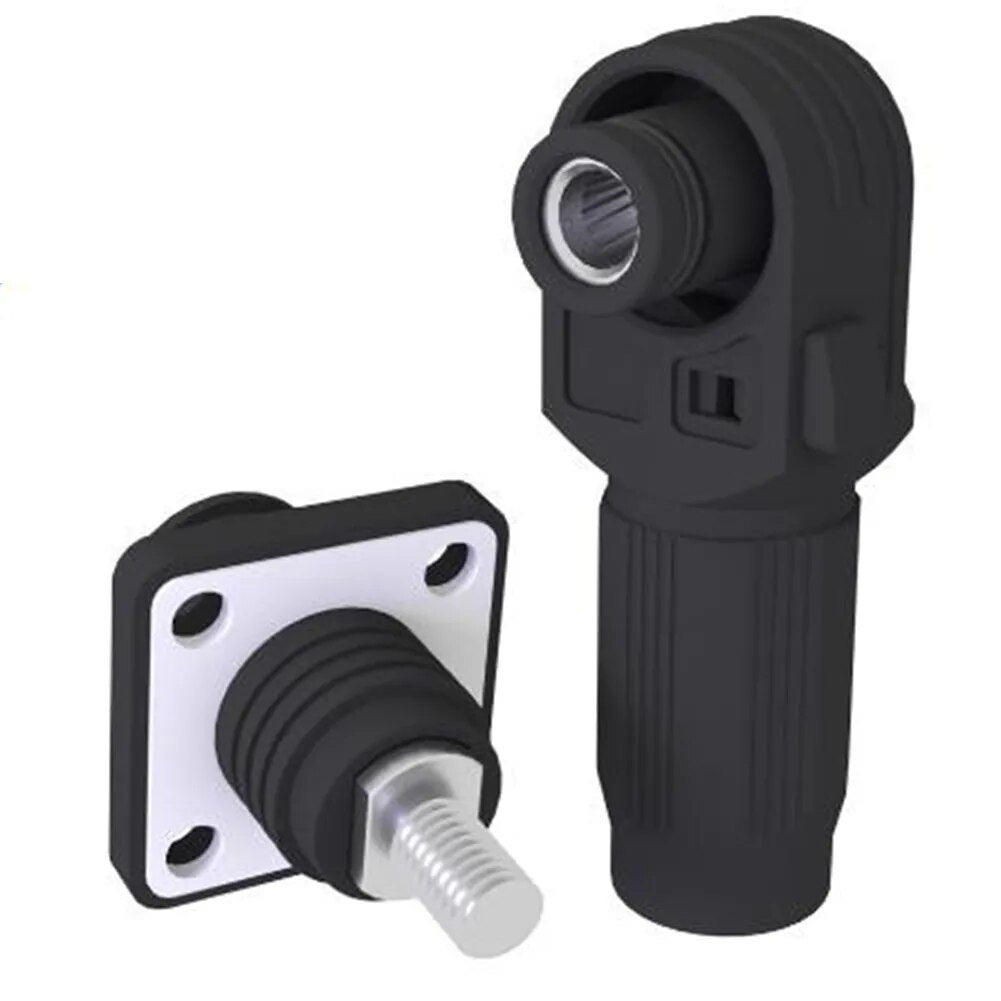
A field installable battery connector with a quick lock, press to release design, built for solar storage, EV conversions, and DIY battery banks. The crown spring contact system delivers a high current, low resistance connection without compression lugs or specialized torque tools on the plug side.
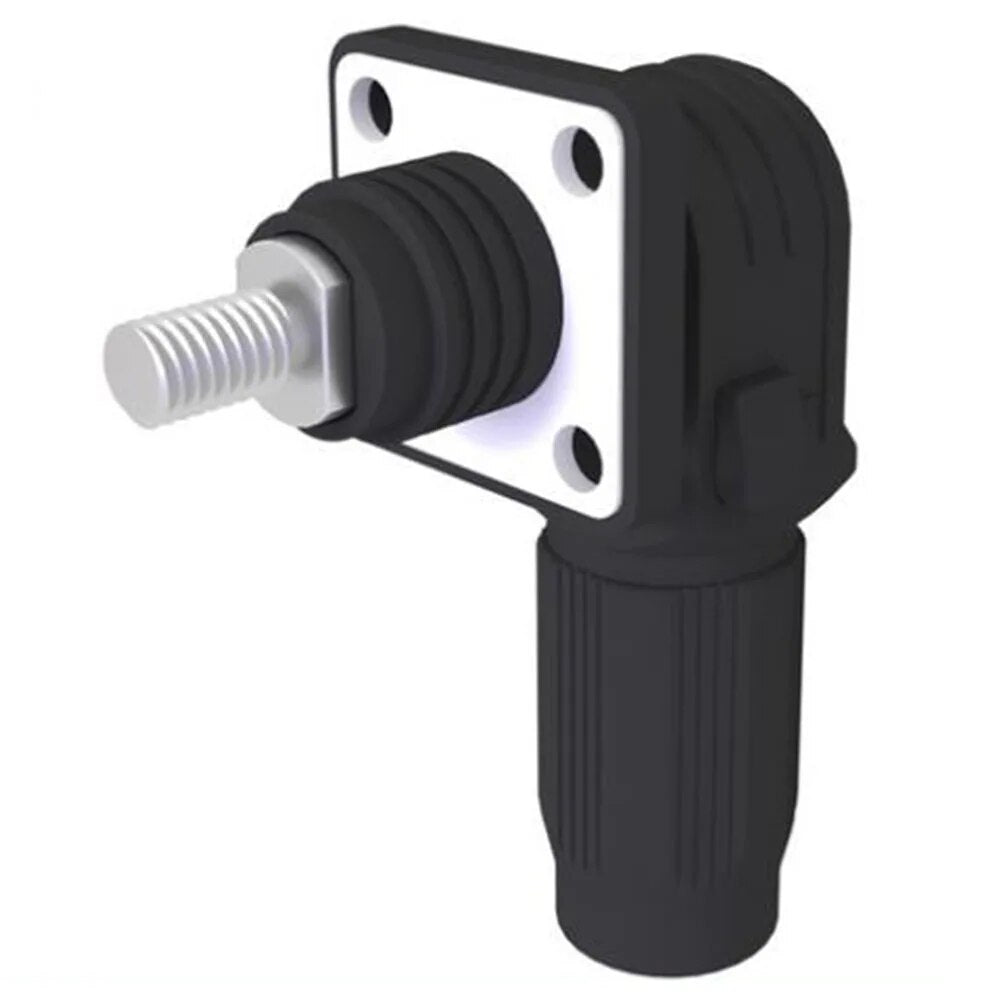
The housing is glass filled PA66 with T2Y pure copper contacts and silver plating. The panel-mount receptacle terminates on a threaded stud, so any standard ring lug bolts straight on. The plug rotates a full 360 degrees for multi-directional cable routing, and the one key side press release makes disconnects fast even inside a crowded battery box. Polarity color coding helps prevent miswiring, and the finger safe IP2X geometry protects against accidental contact when the connector is unmated.
Sealed to IP67 and rated -40°C to 125°C.
Kit Includes
- One panel-mount receptacle with threaded stud terminal
- One right-angle cable plug
- Sealing gasket and mounting hardware
Sizes
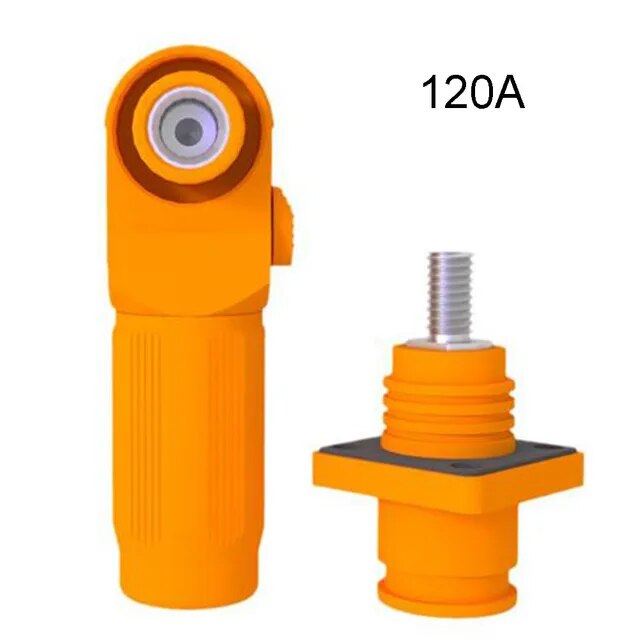
- 120A (LD6 series), 1000V DC max, M6 stud at 3.5 N·m, sized for 4 AWG (25 mm²). Mounts on an 18 mm x 18 mm M4 pattern.
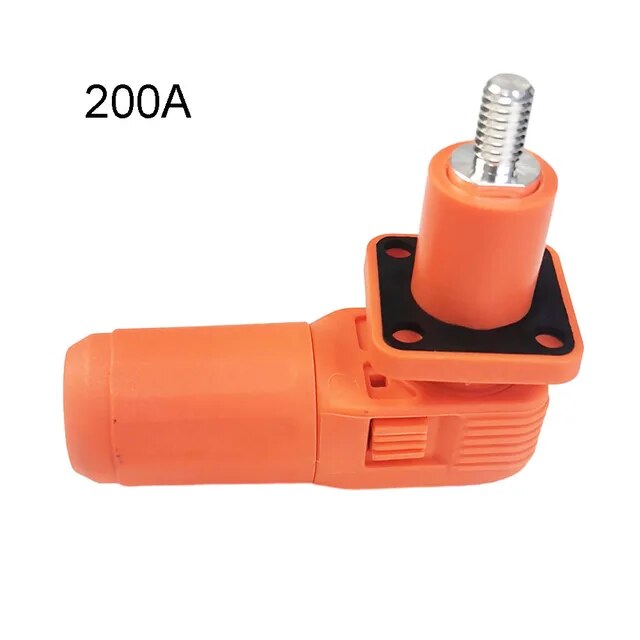
- 200A (LD8 series), 1500V DC max, M8 stud at 6.5 N·m, sized for 1 AWG (50 mm²). Mounts on a 21 mm x 21 mm M4 pattern.
Colors
- Orange, typically used for positive
- Black, typically used for negative
Both colors are mechanically and electrically identical. The color is for polarity identification only, and the plug will physically mate with either receptacle, so label your cables.
Picking a Size
- 12V or 24V build under 3 kW continuous: 120A on 4 AWG covers it with margin.
- 48V rack style or 280Ah prismatic pack feeding a 5 kW inverter: 200A on 1 AWG.
- Nissan LEAF pack at 48V nominal: 200A if you are running a 5 kW or larger inverter, 120A for lighter loads.
- Portable or trailer build where you unplug often: 120A, and size the cable to the connector rather than the other way around.
Size the connector to your inverter's continuous draw, not its surge rating, and never above the ampacity of the cable feeding it.
Do not disconnect under load. This is not a load break connector. Stop power flow at inverter and/or BMS and pull the fuse before unplugging. Hot swapping at high current will arc and damage the contacts.
Technical Specifications
- Housing material: PA66, glass filled, UL94 V-0 flame retardant
- Contact material: T2Y pure copper, silver plated
- Connection technique: crown spring contact
- Receptacle termination: threaded stud, M6 (120A) or M8 (200A)
- Panel mounting: four hole square pattern, M4 screws. 18 mm x 18 mm on center (120A), 21 mm x 21 mm on center (200A)
- Rotation: 360 degree plug rotation
- Release: side press one key disconnect
- Contact resistance: 0.5 mΩ max at 100 mA
- Insulation resistance: greater than 5000 MΩ
- Dielectric strength: 4200V AC per minute
- Mating cycles: 500
- Insertion force: 75 N max
- Protection rating: IP67
- Finger protection: IP2X
- Salt spray: NSS 96 hours
- Operating temperature: -40°C to 125°C
- Number of cores: single core
Questions
Do I need one or two?
Two. Each kit handles one conductor. A battery needs a positive and a negative, so order one orange and one black. If you are building a pack that disconnects at both the battery and the inverter, you need four.
How does my cable attach?
Crimp a ring lug onto your cable, slide it over the receptacle stud, and torque the nut to spec (3.5 N·m on M6, 6.5 N·m on M8). The 10 ton crimper kit handles the lug side. Use a proper crimp, not a set screw lug, at these currents.
Can I unplug it while the inverter is running?
No. It is a connector, not a switch. Shut down the load and turn off the BMS or pull the Class T fuse first. Breaking 200A of DC under load draws a sustained arc that will pit the contacts and can start a fire.
Is the 200A rating continuous?
It is continuous with correctly sized 1 AWG cable, a solid crimp, and reasonable ventilation. Derate if the connector lives inside a sealed enclosure in high ambient heat. The limiting factor in almost every build is the termination quality, not the connector body.
Will it accept 2/0 or 4/0 cable?
Not directly. The 200A version is sized for 1 AWG (50 mm²). If your main run is larger, step down to 1 AWG for the last leg into the connector rather than forcing an oversized lug onto the stud.
Does this replace a BMS, fuse, or disconnect?
No, it replaces none of them. It is a serviceable connection point. You still need a BMS, overcurrent protection, and a rated disconnect switch in the circuit.
Can I mix a 120A plug with a 200A receptacle?
No. The LD6 and LD8 bodies are different sizes and will not mate. Order matching pairs.
What is the mounting pattern?
Both sizes mount on a four hole square pattern using M4 screws. The 120A (LD6) is 18 mm x 18 mm on center. The 200A (LD8) is 21 mm x 21 mm on center. Drill the center clearance hole to suit the connector body, then bolt through with M4 hardware.
Before you check out
Two connectors, one orange and one black • lug crimper • Class T fuse • BMS


