




Product overview
Sodium-ion · 18650 · Layered oxide · Batch C
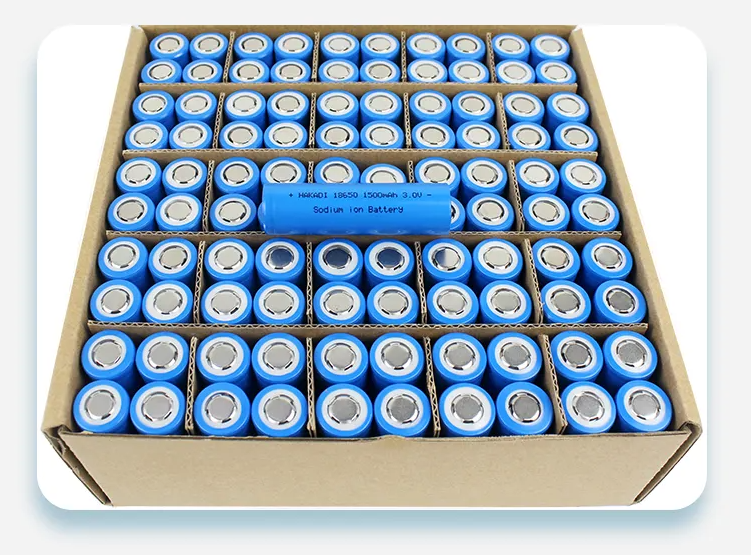
Sodium-ion 18650 battery cells with a layered oxide cathode, sold in 4-packs for DIY 12V, 24V and 48V packs. Each cell is rated 1,100 mAh and 15C (16.5 A) continuous, and discharges down to −40 °C. Charge to 4.00 V per cell and cut off at 2.0 V; a sodium-set BMS and charger are required. The full datasheet, our bench test and BMS setpoints for 4S, 8S and 16S packs are on this page.
- OGS part
- SIB-18650-LO-04
- Capacity
- 1,100 mAhrated at 0.2C · 1,080 min [1]
- Nominal
- 3.0 Vwindow 1.5 to 4.0 V [1]
- Continuous
- 16.5 A15C · 30C (33 A) for 10 s [1]
- Charge
- 4.00 VCC-CV · 0.5C standard · 3C max [1]
- Cycle life
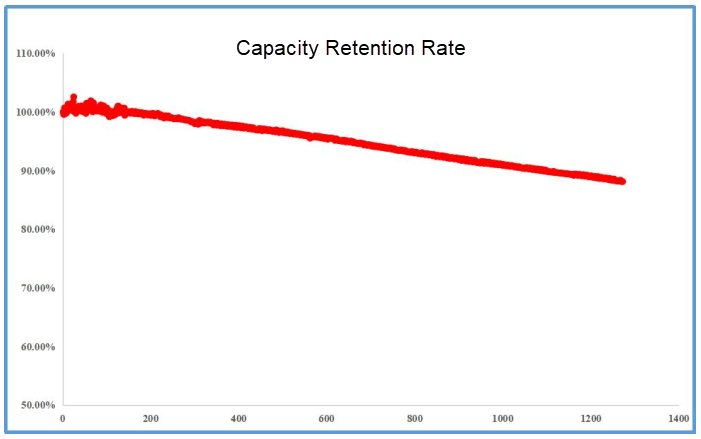
- 2,000 cycto 80 % · 1C discharge, 25 °C [1]
- Discharge temp
- −40 to 70 °Ccharge −10 to 55 °C [1]
- Build
- Flat top · Unprotected · Bare cell · Ships at ≤ 3.0 V
Dimensions mm, drawn to scale
Mass 37.0 ±2 g
Flat top, no protection circuit. Dimensions and tolerances from the datasheet [1].
Why this cell
Works in the cold
−40 °Cdischarge, ≥ 90 % capacity at −20 °C [1]
Charging is the limit: none below −10 °C, 0.15C max from −10 to 0 °C, 0.33C max from 0 to 10 °C [1].
Needs its own charger
4.00 Vcharge voltage, never more [1]
An LFP charger stops too low (3.65 V per cell) and leaves the cell part-charged. A lithium-ion (NMC) charger goes too high (4.2 V per cell). Use a sodium-set charger and BMS: see Works with this cell.
Long life
2,000cycles to 80 % capacity [1]
About 5 years at one full cycle a day. Shallower cycles go further.
Common applications
- LoRa and Meshtastic solar nodes
- Lab and university bench testing of sodium-ion chemistry
- Remote sensors, weather stations and trail cameras that stay out all winter
- Cold-climate backup packs for vans, cabins and ice-fishing shelters
- Small DC backup for routers and ham radio
- Prototype packs for robotics and e-bikes
Specifications every value names its source
| Attribute | Value | Condition and source |
|---|---|---|
| Rated · manufacturercopied from the datasheet [1] | ||
| Chemistry | Sodium-ion, layered oxide | cathode stated on the supplier quotation [2]; the datasheet does not name it |
| Capacity, rated | 1,100 mAh | 0.2C, 1.5 to 4.0 V, 25 ±3 °C [1] |
| Capacity, minimum | 1,080 mAh | same conditions [1] |
| Nominal voltage | 3.0 V | [1] |
| Charge voltage | 4.00 V | CC-CV. §8.1.3: never charge above 4.0 V [1] |
| Maximum voltage | 4.05 V | table 4.1 limit [1]. Set it as BMS over-voltage, never as a charge target |
| Discharge cut-off | 1.5 V | end of discharge [1] |
| Standard charge | 0.5C (0.55 A) | CC-CV to 4.0 V, stop at 0.02C (22 mA), 25 ±3 °C [1] |
| Max charge current | 3C (3.3 A) | [1] |
| Max continuous discharge | 15C (16.5 A) | [1] |
| Max pulse discharge | 30C (33 A) | 10 seconds [1] |
| Internal resistance | ≤ 18 mΩ | test method not stated [1] |
| As shipped | ≤ 3.0 V | partial charge for transport, §11 [1] |
| Performance · manufacturer testtest method in the datasheet, §5 and §6 [1] | ||
| Cycle life | ≥ 80 % at 2,000 | charge 0.5C CC-CV to 4.0 V (0.05C stop), discharge 1C to 1.5 V [1] |
| Capacity at −20 °C | ≥ 90 % | 12 h soak, then 0.5C to 1.5 V [1] |
| Capacity at 60 °C | ≥ 95 % | 8 h soak, then 0.5C to 1.5 V [1] |
| Rate capability | ≥ 95 % at 3C | English text says 3C, Chinese text says 5C [1]. We show the lower rate |
| Charge retention, 28 days | ≥ 90 % | full charge, 25 °C. ≥ 95 % recovered after a recharge [1] |
| Charge retention, 7 days at 55 °C | ≥ 90 % | ≥ 95 % recovered [1] |
| Temperature[1] | ||
| Charge, −10 to 0 °C | 0.15C max | to 4.0 V [1] |
| Charge, 0 to 10 °C | 0.33C max | to 4.0 V [1] |
| Charge, 10 to 55 °C | 0.5C | standard CC-CV to 4.0 V [1] |
| Discharge | −40 to 70 °C | at 0.5C [1] |
| Storage | 0 to 35 °C | over 3 months: dry, 1.5 to 4.0 V, cycle once every 3 months [1] |
| Calculatedarithmetic on [1] and [3], shown so you can check it | ||
| Energy per cell | 3.3 Wh | 1.1 Ah × 3.0 V |
| Energy density, gravimetric | ≈ 89 Wh/kg | 3.3 Wh ÷ 37.0 g |
| Energy density, volumetric | ≈ 189 Wh/L | 3.3 Wh ÷ 17.4 cm³ (cylinder, 18.4 × 65.5 mm) |
| Standard discharge | 0.5C (0.55 A) | the rate the datasheet uses for its capacity and temperature tests [1] |
| Usable capacity, typical inverter window | ≈ 67 to 79 % | 12V inverters cut off near 10.0 to 10.5 V, or 2.5 to 2.6 V per cell. Share of the capacity above that, at 0.5C [3] |
| Energy per 4-pack | 13.2 Wh | 4 × 3.3 Wh |
OGS bench test our own charge and discharge
These results are from the previous batch of this cell (batch B, 1,300 mAh). Our test of the current 1,100 mAh batch C cell is next and will replace them.

- Capacity delivered
- 1,216 mAh 94 % of the 1,300 mAh rating, at 0.5C
- Charge back out
- 98 % 1,216 mAh out of 1,239 mAh put in
- Energy back out
- 86 % 3.51 Wh out of 4.06 Wh in, test-lead loss included
One cell, room temperature, charged to 3.95 V and discharged at 0.5C to 1.80 V. Full method in the test report.
BMS and charger setpoints
Per-cell values from the datasheet [1], multiplied out for common packs. For batch C cells only.
| Setpoint | Per cell | 4S | 8S | 16S |
|---|---|---|---|---|
| BMS over-voltageabsolute maximum [1] | 4.05 V | 16.2 V | 32.4 V | 64.8 V |
| Charge voltage (CV)charger setpoint [1] | 4.0 V | 16.0 V | 32.0 V | 64.0 V |
| Nominal[1] | 3.0 V | 12.0 V | 24.0 V | 48.0 V |
| Low cut-off, working2.0 to 2.2 V keeps nearly all the capacity [3]. Use 2.5 V if your inverter needs it; that gives up about a fifth | 2.0 V | 8.0 V | 16.0 V | 32.0 V |
| BMS under-voltageabsolute floor [1] | 1.5 V | 6.0 V | 12.0 V | 24.0 V |
Batch history
Charge and discharge voltages differ by batch. Use the row that matches the cells you have. Not sure which you have? Send us your order number.
Works with this cell parts we sell that are set up for it
BMSpre-programmed for sodium
 12 V sodium BMS, 4S200 A, Bluetooth, active balance$185.00
 24 V sodium BMS, 8S200 A, Bluetooth, active balance$185.00
 48 V sodium inverter BMS, 16S200 A, CAN / RS485 to the inverter$329.00
Chargersset to sodium voltages
 12 V sodium charger, 4S$286.00
 24 V sodium charger, 8Sfrom $587.00
 48 V sodium charger, 16Sfrom $429.00
Pack build18650 format
 4S 18650 holder$26.00
 Pure nickel stripfrom $11.00
 801D spot welder$472.00
Testcheck cells before you build
 EBC-A20 capacity tester$200.00
 Internal resistance tester$101.00
Questions builders ask
What BMS do I need for sodium-ion 18650 cells?
One set to sodium voltages: over-voltage 4.05 V and under-voltage 1.5 V per cell. Our 12V, 24V and 48V sodium BMS ship pre-programmed for these cells.
Can I charge sodium-ion cells below freezing?
Yes, slowly, down to −10 °C: 0.15C max from −10 to 0 °C and 0.33C max from 0 to 10 °C. Do not charge below −10 °C.
Will a 4S sodium-ion pack work with my 12V inverter?
Usually, but check the inverter's low-voltage cut-off. A 4S pack runs from 16.0 V full down to 8.0 V. At a 10.0 to 10.5 V cut-off you use about two thirds to four fifths of the capacity; at 8.0 V (2.0 V per cell) you use nearly all of it.
Layered oxide or NFPP sodium-ion cells?
Layered oxide holds more energy per cell and handles more current. NFPP costs less and has a flatter voltage curve. Our NFPP vs layered oxide post compares them in detail.
Can I use an LFP or lithium-ion charger?
No. An LFP charger stops too low (3.65 V per cell) and a lithium-ion charger goes too high (4.2 V per cell). These cells need a charger set to 4.00 V per cell.
Related reading
- Sodium-ion pack mathSeries count, voltage window and BMS settings for 12 V to 72 V packs
- Bench test report v1Our discharge curves: NFPP, layered oxide and LFP
- NFPP vs layered oxideWhich sodium chemistry fits your build
- How to spot weld 18650 cellsNickel strip, weld settings and insulator rings
Sources
- [1] Manufacturer product specification for this cell, version A0, approved 2026-02-04, 11 pages. Linked under Downloads.
- [2] Supplier quotation for this batch, 2026-08-29. It states a layered oxide cathode. The datasheet does not name the cathode.
- [3] OGS bench test report v1 (earlier sodium 18650 batches, 0.5C, room temperature). A recommendation, not a manufacturer rating.