OGSolarStore
Battery Pack Capacity Tester, 12-72V 20A - Zketech EBC-B20H
Battery Pack Capacity Tester, 12-72V 20A - Zketech EBC-B20H
In stock
Couldn't load pickup availability
- ✓ Stocked in Michigan
- ✓ Sourced from Certified Manufacturer
Share
The ZKETECH EBC-B20H is a pack-level capacity tester. It runs a real constant-current discharge on an assembled 12 V to 72 V battery at up to 20 A, measures what actually comes out in amp-hours and watt-hours, and plots the whole curve on your PC. Paired with your own charger it also meters the charge going back in, so you can log a complete cycle.
This is the instrument you reach for when the pack is already built. Cell testers stop at 5 V and bench loads stop at 30 V. The B20H is for the 24 V, 36 V, 48 V and 72 V packs that most people are actually buying, building and selling: server rack batteries, e-bike and scooter packs, golf cart banks, RV and off-grid batteries.
Read this first: there is no charger inside. The B20H is a discharge tester with a charge-monitoring mode. In CHG mode you connect your own charger to the posts on the rear panel, and the B20H meters the charge and stops the run when current tapers below the value you set. If you want a full charge-discharge cycle, you need a charger for your pack voltage. If you only want a capacity number, you do not.
Key features
- 12–72 V pack coverage, with a settable cutoff anywhere from 8.00 V to 88.00 V, so it handles lead-acid, LiFePO₄, Li-ion and LTO packs at any series count in that window.
- Programmable constant-current discharge, 0.10–20.00 A in 0.01 A steps. Set the current, set the cutoff voltage, walk away.
- Real capacity measurement in amp-hours and watt-hours, resolved to 0.001 Ah on small packs and 0.1 Ah past 100 Ah.
- Charge metering with an external charger, stopping automatically when charge current falls below your set value.
- Four-wire measurement. Voltage and current on separate channels, so lead resistance and connector drop do not corrupt the reading. On a 48 V pack at 20 A this is the difference between a measurement and a guess.
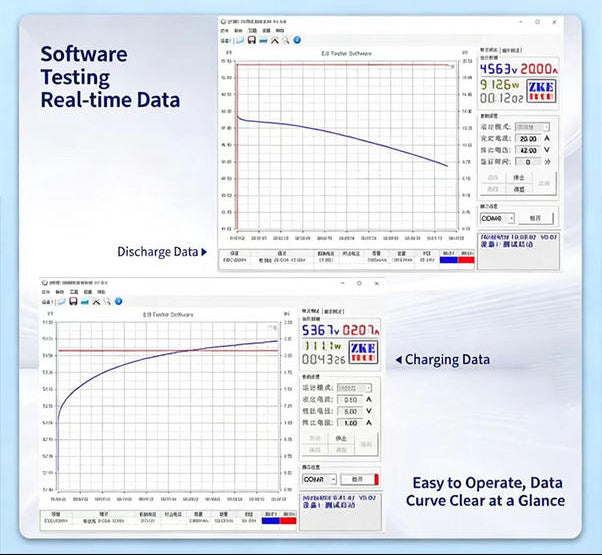
- PC software with real graphing. The free EB Tester software plots voltage and current against time and stores the run, so you can show a customer the curve rather than a claim.
- Standalone operation. Front-panel buttons and LCD, no computer required. The software adds graphing and logging.
- Universal AC input, 100–240 V, so it runs on US mains as shipped.
What you can test
| Pack | Full-charge voltage | Discharge test? |
|---|---|---|
| 12 V lead-acid, AGM, golf cart | 12.7–14.8 V | Yes, at up to 10 A |
| 12 V LiFePO₄ (4s) | 14.6 V | Yes, at up to 10 A |
| 24 V pack (8s LiFePO₄, 2x12 V lead-acid) | 29.2 V | Yes |
| 36 V pack (10s Li-ion, e-bike) | 42.0 V | Yes |
| 48 V pack (16s LiFePO₄, server rack, golf cart) | 54.4–58.4 V | Yes |
| 52 V / 60 V pack (14s–16s Li-ion) | 58.8–67.2 V | Yes |
| 72 V pack (20s Li-ion, 24s LiFePO₄) | 84.0–87.6 V | Yes, up to the 88 V ceiling |
| Single cell, or anything under 8 V | under 8 V | No. Use a single-cell tester such as the EBC-A40L |
| 96 V and above | over 88 V | No, this is the hard ceiling |
Testing loose cells instead of a pack? The B20H starts at 8 V. For single cells look at the EBC-A40L (5 V, 40 A); for packs up to 30 V where you also want charging built in, the EBC-A20.
How much current can you actually pull?
Two limits apply. The 12 V rule is in the manual: on a 12 V pack the maximum discharge current is 10 A, not 20 A. Above that the full 20 A range is available, subject to the unit’s power dissipation limit.
In practice most capacity tests are run well below the maximum anyway. A 0.2 C test on a 100 Ah pack is 20 A, and on a 280 Ah bank a 20 A test is a gentle 0.07 C. The amp-hour figure is just as accurate at a lower current; the test simply takes longer.
Worked example: capacity-testing a 48 V 100 Ah server rack battery
The common case: a rack battery, new or used, that claims 100 Ah and 5 kWh. Here is how you find out.
| Step | Mode | Settings | What happens |
|---|---|---|---|
| 1 | Charge first, with your own charger | Charger set to 56.0 V · tester in CHG mode · cutoff current 5 A | The pack is brought to a true full charge and the tester stops the run as current tapers. A capacity test only means something if it starts from full. |
| 2 | DSC (discharge, constant current) | Current 20 A · Cutoff 44.8 V | Draws a steady 20 A until the pack reaches 2.8 V per cell. This step produces your capacity figure in Ah and Wh. About 5 h on a healthy 100 Ah pack. |
| 3 | Recharge | Charger set to your normal float or storage voltage | Leaves the pack in a sensible state rather than sitting empty. |
Set your cutoff above the BMS low-voltage disconnect, not below it. If the BMS trips first, the test ends early and the capacity number is wrong. On a 16s LiFePO₄ pack, 44.8 V (2.8 V per cell) is a sane target that leaves the BMS out of it. For a 12 V lead-acid battery use 10.5 V and expect the rated capacity only at the 20-hour rate.
Reading your results
The software plots voltage and current against time. In a constant-current discharge the current trace holds flat while the voltage trace slides down to your cutoff, and the run reports measured capacity in amp-hours alongside watt-hours.
Watt-hours are the honest number on a pack. A 48 V 100 Ah battery advertised at 5.12 kWh that delivers 4.1 kWh has told you something specific, and the curve tells you why. A pack that sags steeply from the start has high internal resistance, tired cells, or a connection problem. A pack that tracks normally and then falls off a cliff early usually has one weak cell dragging the string down, which is a balancing or cell-replacement job rather than a dead pack. LiFePO₄ holds a long flat plateau and then drops sharply at the end; lead-acid slopes steadily the whole way.
Save the run. A dated discharge curve is the difference between "the battery seems weak" and a warranty claim a supplier will act on.
Technical specifications
| Parameter | Value |
|---|---|
| Model designation | EBC-B20H: 12–72 V pack tester, 20 A |
| Power supply | AC 100–240 V |
| Battery packs supported | 12 V, 24 V, 36 V, 48 V, 60 V, 72 V nominal |
| Discharge voltage range | 0.10–89.00 V |
| Cutoff voltage setting | 8.00–88.00 V in 0.01 V steps |
| Discharge current | 0.10–20.00 A in 0.01 A steps (10 A maximum on 12 V packs) |
| Maximum discharge power | |
| Charging | External charger required. CHG mode meters the charge and stops when current falls below the set value |
| Accuracy | ±0.5 % on voltage and current |
| Capacity resolution | Under 10 Ah: 0.001 Ah · 10–100 Ah: 0.01 Ah · Over 100 Ah: 0.1 Ah |
| Test timer | 0–999 minutes per step; set 0 for no time limit |
| Connections | Two front-panel aviation sockets for the battery (positive left, negative right), red and black charger-input posts on the rear panel |
| Measurement | Four-wire, voltage and current channels separated |
| Display | LCD showing mode, voltage, current, elapsed time, capacity and energy |
| PC connection | Dedicated USB-TTL cable, for graphing, calibration and firmware updates |
| Dimensions and weight | |
| Shipping box |
What’s in the box
- ZKETECH EBC-B20H battery pack tester
- AC power cord
- USB-TTL communication cable for PC connection
- Test leads with clips
- Printed user manual, plus software download links
Connecting to your computer
The tester works fully standalone using its front-panel buttons. The software is what turns a number into evidence: a saved, dated curve you can send to a supplier or show a buyer.
- Install the USB-TTL driver, then install the EB Tester software. Download links for both are in the manual and at zketech.com.
- Windows in S Mode? You will need to leave it first, or Windows will block the install. Open the Microsoft Store, search “switch out of S mode”, and click Get.
- Power on the tester and connect the included USB adapter between the tester and your PC.
- Open EB Tester and find Comm Setting. Choose your COM port and click Connect. It is usually a number between COM3 and COM9. If no port appears, the driver has not installed correctly.
Windows only. ZKETECH has confirmed the EB Tester software does not currently run on macOS. Mac users can still operate the tester manually from its front panel, but cannot graph or log runs.
Typical applications
- Verifying the real capacity of a used e-bike, scooter, golf cart or EV pack before you buy it or after you rebuild it
- Incoming inspection on 48 V server rack batteries, against the number on the label
- Annual capacity check on an off-grid or backup bank, to track degradation year over year
- Proving out a pack you just assembled, before it goes into service
- Grading and pricing used packs for resale, with a curve attached
- Documenting capacity loss for a warranty claim
- Load-testing 12 V and 24 V lead-acid banks at a controlled current instead of a carbon pile
Safety and usage notes
- 88 V is the ceiling. Do not connect a 96 V or higher pack.
- Never reverse polarity, and make your connections before starting the run.
- Leave the BMS connected and set your cutoff voltage above its low-voltage disconnect, or the BMS will end the test for you and the reading will be short.
- Size your leads for the current and make solid terminal connections. Poor contact at 20 A means heat and a skewed measurement.
- Keep the vents clear. Everything you pull out of the pack leaves this unit as heat, and the fan needs airflow around the case.
- 12 V packs are limited to 10 A. This is a design limit, not a fault.
- Use the supplied USB-TTL cable. An ordinary USB cable will not communicate; the supplied cable contains a serial converter.
- Run tests in a clear, non-flammable area with ventilation, and do not leave a suspect pack discharging unattended overnight.
Frequently asked questions
Does it charge the battery?
Not on its own. There is no charger inside. In CHG mode you connect your own charger through the tester and the B20H meters the charge and stops it when current tapers below your set value. For discharge and capacity testing, nothing else is needed.
What charger do I need?
Any bench or pack charger that matches your pack voltage and chemistry, with an adjustable or correct charge voltage. If you only want a capacity number, you can charge the pack however you normally do and use the B20H for the discharge alone.
Can it test a 96 V or 100 V pack?
No. The measurement range tops out at 89 V and the cutoff setting at 88 V, which covers 72 V nominal packs at full charge and nothing higher.
Why is my 12 V battery limited to 10 A?
That is the specified limit for 12 V packs. The full 20 A range applies to higher pack voltages.
Can it test a single cell?
No. The lowest cutoff you can set is 8 V. For single cells look at the EBC-A40L (5 V, 40 A) or the EBC-A20.
How long does a test take?
Capacity divided by current. A 100 Ah pack at 20 A is about 5 h; a 280 Ah bank at 20 A is about 14 h. Set the step timer to 0 so nothing cuts the run short.
Does it work on a Mac?
Not for the software. ZKETECH has confirmed EB Tester is Windows only. Manual front-panel operation works regardless.
Do I need a computer to use it?
No. Current, cutoff and timer are all settable from the front panel and the LCD shows the running capacity. The software adds graphing and saved runs.
Downloads and support
User manual: Download the official EBC-B20H user manual (PDF)
Software: The EB Tester software and USB-TTL driver are free downloads from zketech.com, with links provided in the manual.
System requirements: Windows 7, 8, 10 or 11 with a free USB port and administrator rights to install the driver. Not compatible with macOS.