OGSolarStore
Internal Resistance Tester for Large Prismatic Cells - RC3563, 4-Wire, 1 kHz AC, 0-100V
Internal Resistance Tester for Large Prismatic Cells - RC3563, 4-Wire, 1 kHz AC, 0-100V
Available to order Ships in 4 weeks.
Couldn't load pickup availability
- ✓ Ships from Michigan
- ✓ True 4-wire Kelvin for big prismatic cells
- ✓ Trusted Supplier
Share
The RC3563 measures a cell's internal resistance and voltage at the same time, using a true four-wire (Kelvin) connection and a 1 kHz AC test signal. It is the tester we suggest for the big prismatic cells most DIY packs are built from today: 280Ah, 314Ah and 628Ah LiFePO4. Those cells sit around 0.15 to 0.25 milliohms (mΩ), below the range many low-cost meters are designed for.
Building with 18650s or smaller cells and want built-in pass/fail sorting? Our TR1035 internal resistance tester is the better fit. Not sure which one you need? Read our guide: TR1035 vs RC3563: which internal resistance tester?
At a glance
- True 4-wire Kelvin measurement, so lead and contact resistance stay out of the reading
- 1 kHz AC internal resistance (ACIR), the same method cell makers use for their datasheet value
- Reads resistance and voltage at the same time, 5 updates per second
- Resistance up to 200 Ω in 6 ranges (auto or manual); voltage up to ±100 VDC in 3 ranges
- Basic accuracy 0.5% (resistance and voltage)
- User calibration of every range, one at a time
- Serial output with free PC software for logging and sorting
- Rechargeable 1000 mAh battery, charges from any 5 V USB phone charger
- Ships from the USA
Specifications
| Measurement | AC internal resistance, 4-wire Kelvin |
| Test frequency | AC 1 kHz |
| Test current | 50 mA (20 mΩ range); 5 mA (200 mΩ and 2 Ω); 0.5 mA (20 Ω and 200 Ω) |
| Resistance range | Up to 200 Ω, 6 ranges, auto and manual |
| Voltage range | 1 mV to ±100 VDC, 3 ranges, auto and manual |
| Basic accuracy | Resistance 0.5%, voltage 0.5% |
| Display update | 5 times per second |
| Calibration | Each resistance and voltage range calibrated on its own; one-key factory reset |
| PC connection | Serial, 115200 baud (off by default) |
| Power | Internal 1000 mAh lithium battery, 5 V / 1 A USB charging; auto-off after 10 minutes |
| Test lead length | About 1 m |
| Size and weight | 166 x 80 x 28 mm, 190 g |
| Operating temperature | -10 °C to +40 °C |
Getting a good reading on a big prismatic cell
- Clamp the terminal, not the busbar. On a 280Ah cell the terminal, nut or busbar can have more resistance than the cell itself. Measure on bare, clean terminals.
- Same spot, same temperature, every cell. At 0.2 mΩ small changes in probe position show up. Matching cells is about consistency between cells, not the absolute number.
- Keep the leads parallel and away from inverters or transformers, as the manual advises, to cut interference.
- Check all four wires are connected. The meter doesn't warn you about an open lead; it shows an unstable or impossible value instead.
- Don't measure while the cell is charging or discharging, and never connect it to AC.
What internal resistance tells you (and what it doesn't)
A 1 kHz AC reading is lower than the DC resistance that sets voltage sag under load; for most cells it is roughly 70% of the DC value. Use it to compare cells of the same model and to spot an outlier. It does not measure capacity. To grade a cell's real amp-hours, run a capacity test with a tester like the EBC-A40L.
In the box
- RC3563 tester
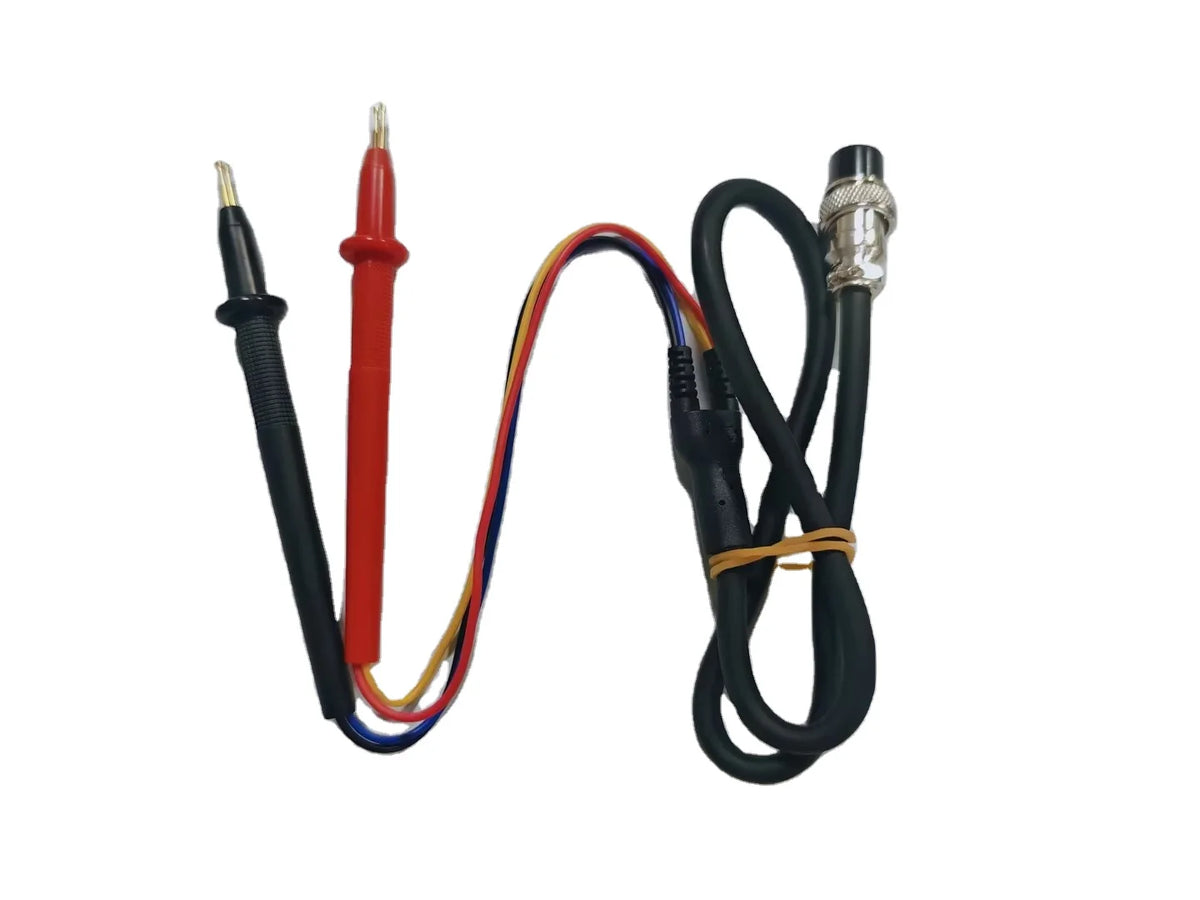
- 4-wire Kelvin clamp leads, for prismatic cell terminals
- 4-wire probe pin leads, for small terminals and tabs
- Cylindrical cell holder (18650 size)
- USB cable