


OGSolarStore
18650 Sodium-Ion Battery Cell (Layered Oxide) Na-ion for DIY 12V, 24V, 48V Battery Packs
18650 Sodium-Ion Battery Cell (Layered Oxide) Na-ion for DIY 12V, 24V, 48V Battery Packs
Available Lead time 2 weeks.
Couldn't load pickup availability
- ✓ Ships in 2 business days
- ✓ Tested before shipping
Share
Build your own 12V, 24V, 48V, or 72V DIY battery pack with these 18650 sodium-ion cells, the cost-effective alternative to lithium-ion and LFP for off-grid solar, e-bikes, and cold-climate storage.
Drop-in 18650 form factor that works with the holders, spot welders, and nickel strip you already have. Sodium-ion runs at a lower cell voltage than lithium, so the series counts and BMS settings are different. Everything you need to design around that is below.
Current Batch Specs
Shipping now: Batch 2026-A · Manufacturer P/N NaFR18650CY-1.1Ah · 1,100 mAh · 3.0V nominal.
Sodium-ion is a fast-moving chemistry and our stock rotates. The specs in this box describe the cells currently in inventory. If you are matching an existing pack, read the note on batch variation at the bottom of this page before you order.
| Form Factor | 18650 (18.4 ±0.2 mm x 65.5 ±0.3 mm) |
| Chemistry | Sodium-ion, layered oxide cathode (per supplier) |
| Nominal Voltage | 3.0V |
| Rated Capacity | 1,100 mAh (1,080 mAh minimum) |
| Energy | ~3.3 Wh per cell |
| Energy Density | ~89 Wh/kg |
| Charge Target / Absolute Max | 4.00V CC-CV / 4.05V |
| Discharge Cut-off | 1.50V |
| Max Continuous Discharge | 15C (16.5 A) |
| Max Pulse Discharge | 30C (33 A) for 10 seconds |
| Max Charge Current | 3C (3.3 A) |
| Internal Resistance | ≤18 mΩ |
| Cycle Life | 2,000 cycles to 80% SOH (1C discharge, 25°C) |
| Charge Temperature | -10°C to 55°C (derated below 10°C) |
| Discharge Temperature | -40°C to 70°C |
| Storage Temperature | 0°C to 35°C |
| Weight | 37.0 ±2 g |
Derated charge rates by temperature: -10°C to 0°C at 0.15C · 0°C to 10°C at 0.33C · 10°C to 55°C at full 0.5C CC-CV. Cells ship at partial state of charge (at or below 3.0V) per transport rules.
Why Sodium-Ion Instead of LFP or Lithium-Ion
- Cold-weather performance. This batch discharges down to -40°C and accepts a reduced charge current at -10°C, where LFP and NMC either lose a large fraction of capacity or refuse to charge at all.
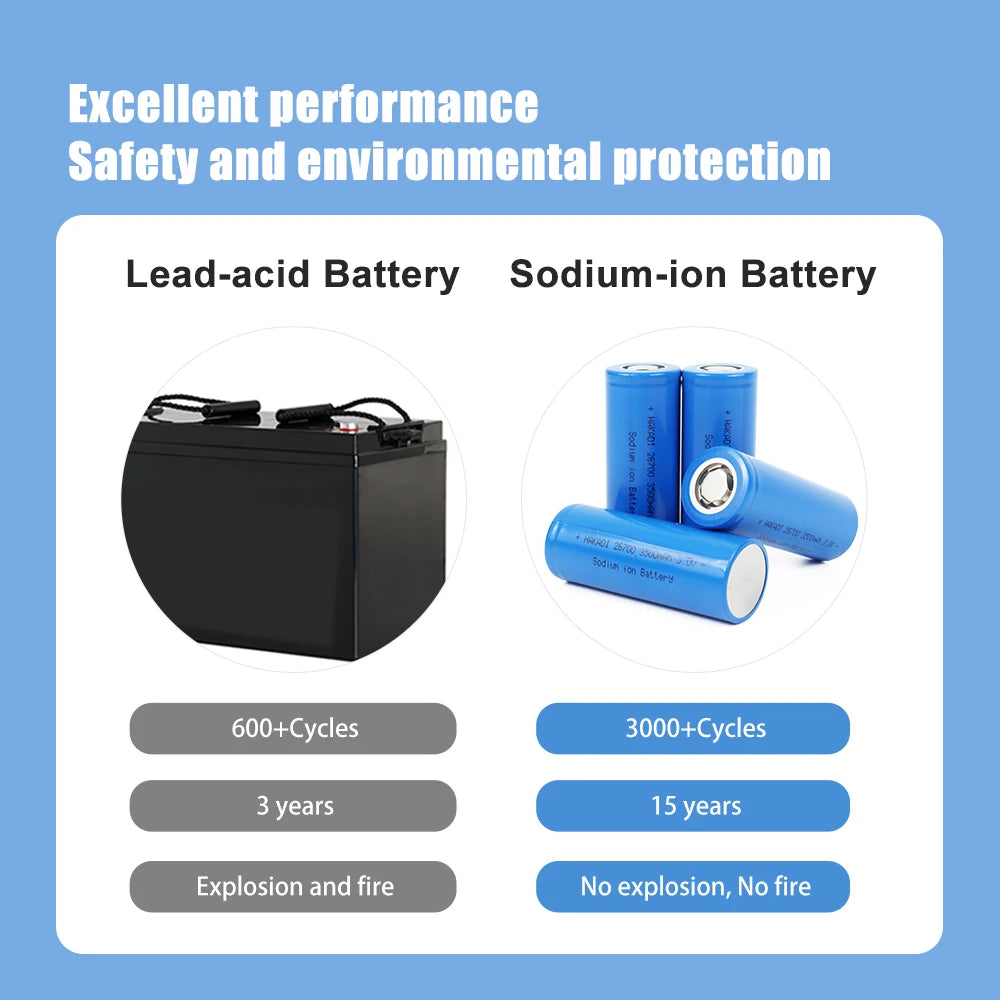
- Safer chemistry. No cobalt, and sodium-ion cells tolerate abuse that puts lithium cells into thermal runaway. These cells pass overcharge to 6V, dead-short, crush, nail, and 130°C hot-box testing with no fire and no explosion. A sodium cell can also be shipped and stored at 0V without permanent damage, which lithium cannot.
- Stable supply chain. Sodium is refined from abundant soda ash and salt, not from lithium brine or hard rock with concentrated geography.
- Standard 18650 form factor. Same holders, spot welders, and nickel strip you already use, plus any BMS that lets you set custom voltage thresholds.
The honest trade-off: sodium-ion carries less energy per pound than LFP or NMC. If you need maximum range per kilogram for a long-distance EV, buy LFP. If you want a cold-tolerant, high-cycle, abundant chemistry for stationary storage, off-grid solar, light mobility, or any pack that sees real winters, sodium-ion is the better pick.
How to Build a 12V, 24V, 36V, 48V, or 72V Sodium-Ion Pack
Sodium-ion runs lower per cell than LFP (3.2V) and well below lithium-ion (3.7V), so the series counts differ from a lithium build. Do the math from the cell voltages in the Current Batch box above. The formula never changes even if the cell does:
- Pack nominal voltage = series count (S) x cell nominal voltage
- Pack charge voltage = series count (S) x cell charge target
- Pack capacity in Ah = parallel count (P) x cell capacity in Ah
- Pack energy in Wh = pack nominal voltage x pack capacity in Ah
Worked out for the batch currently in stock (3.0V nominal, 4.00V charge target):
| Target Pack | Series (S) | Nominal Voltage | Charge Voltage | Practical Low Cut-off | Cells (1P) |
|---|---|---|---|---|---|
| 12V | 4S | 12.0V | 16.0V | 10.0V | 4 cells |
| 24V | 8S | 24.0V | 32.0V | 20.0V | 8 cells |
| 36V | 12S | 36.0V | 48.0V | 30.0V | 12 cells |
| 48V | 16S | 48.0V | 64.0V | 40.0V | 16 cells |
| 72V | 24S | 72.0V | 96.0V | 60.0V | 24 cells |
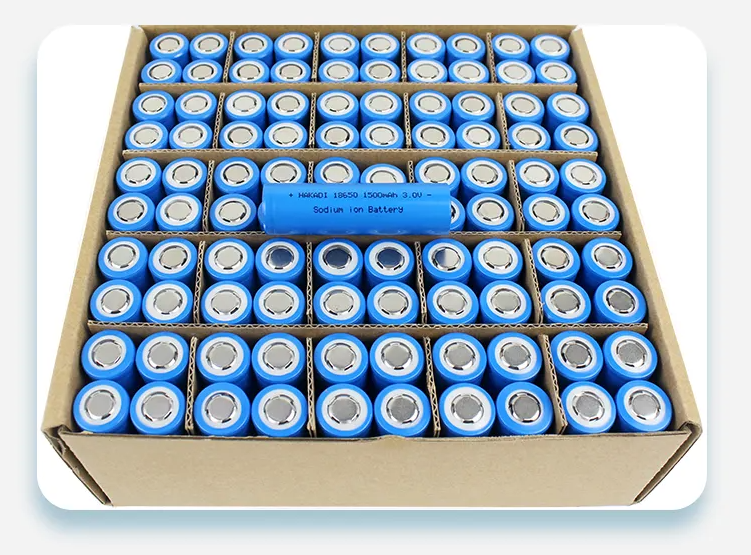
Add cells in parallel (2P, 4P, 5P and so on) to scale capacity. A 16S5P 48V pack uses 80 cells, fits inside our 100-pack with 20 spares, and delivers 5.5Ah at roughly 264Wh.
A note on that low cut-off column. The cell is rated safe down to 1.50V, but the sodium discharge curve slopes hard at the bottom and there is very little usable energy left below about 2.5V per cell. Most inverters and controllers will also fault out long before a 16S pack reaches 24V. Setting your BMS low cut-off around 2.5V per cell captures nearly all the usable capacity, keeps the pack inside your inverter's input window, and leaves headroom against cell-to-cell drift. Use the 1.50V figure as the absolute floor, not as your working setpoint.
BMS and Charger Setup
Do not use a lithium charging profile. Pull your setpoints from the Current Batch box above:
- Per-cell charge target: 4.00V (absolute max 4.05V)
- Per-cell nominal: 3.0V
- Per-cell working low cut-off: 2.5V recommended (absolute floor 1.50V)
- Charge only at -10°C and above, and derate the current below 10°C
BMS. A stock lithium-ion BMS will not work out of the box, the voltage thresholds are wrong in both directions. You need either a sodium-ion specific BMS or a programmable lithium BMS that lets you set custom charge and discharge cut-offs. Daly, JK, and ANT units in their programmable variants are the ones sodium DIY builders reach for most. Confirm the model you buy allows a cut-off as low as 1.5V per cell, some programmable lithium BMS units will not go below 2.0V.
Charger. Use a constant-current / constant-voltage (CC-CV) supply set to the pack charge voltage from the table above, with the termination current set around 0.02C to 0.05C. Do not connect an LFP or lithium-ion charger without reconfiguring the output. Its voltage will be wrong for sodium chemistry in a way that either undercharges the pack badly or pushes it past the safe ceiling.
Understanding Sodium-Ion Cathode Chemistries
Sodium-ion is not one chemistry, it is three cathode families with meaningfully different behavior. Knowing which family a cell belongs to tells you its voltage window, its cycle life, and what it is good for.
| Characteristic | Layered Oxide | Polyanion (NFPP) | Prussian Blue Analog |
|---|---|---|---|
| Typical Nominal Voltage | 3.0 to 3.2V | 3.0V | 3.2V |
| Typical Voltage Window | 1.5 to 4.1V | 1.5 to 4.0V | 2.0 to 4.0V |
| Energy Density | 80 to 160 Wh/kg depending on the metals used | 80 to 110 Wh/kg | Moderate |
| Cycle Life | 1,000 to 3,000 cycles | 2,000 to 4,000 cycles | 1,000 to 2,000 cycles |
| Discharge Curve | Smooth and continuously sloping | Stepped, with distinct plateaus | Sloping |
| Thermal Stability | Moderate to high | High | Moderate |
| Best For | General purpose, mobility, weight-sensitive builds | Stationary storage, high-current loads, long service life | Low-cost bulk storage |
Where this batch sits. Our supplier specifies a layered oxide cathode. Worth knowing that layered oxide is a wide family, not a single recipe. High-nickel versions chase energy density and land at the top of that 160 Wh/kg range. Low-cost iron and manganese versions trade energy density for cycle life, rate capability, and price, and land near the bottom. This batch measures out around 89 Wh/kg with high rate and cycle figures, which puts it firmly in the iron and manganese end of the family. That is the right trade for stationary storage and cold-weather work, and the wrong trade if you are counting grams.
Who These Cells Are For
- Off-grid solar and stationary storage. Cycle life and thermal tolerance matter more than weight in a pack that sits in a shed, a garage, or a battery box.
- Cold-climate builds. Unheated cabins, winter camping, trailers, and anywhere charging at freezing temperatures kills an LFP pack.
- High-current loads. At 15C continuous, a modest parallel count delivers serious amperage. A 10P group handles 165A continuous.
- E-bikes, scooters, and light mobility where cost per cycle beats grams per watt-hour.
- Learning and prototyping. Sodium cells are the forgiving way to learn pack building. Over-discharge one and you have a lesson, not a fire.
Spot Welding Recommendations
Sodium-ion cells do not take the same weld energy as lithium cells. Too much power damages the cell internally in ways you will not see until the pack underperforms.
- Start at the lowest power setting your welder offers.
- Keep each weld under 1.5 seconds.
- If the tab does not hold, raise the power one step and repeat until the weld is secure. Stop at the first setting that works.
- Pull-test a sacrificial cell before committing to a full pack.
A Note on Batch Variation
Sodium-ion is still a young, fast-moving chemistry, and cell manufacturers revise their products far more often than they do in the mature lithium world. The cells we stock change as better ones reach the market, which means capacity, nominal voltage, charge and discharge cut-offs, and cycle life can all differ from one batch to the next. The Current Batch box at the top of this page always reflects what is shipping today, and the matching datasheet is linked below.
What this means for your build:
- Do not mix batches inside one series string. Cells of different capacity or different voltage windows will not balance, and the smallest cell in the string sets the usable capacity of the whole pack.
- Buy all the cells for a pack in one order, including your spares. If you plan to expand later, order the extra cells now.
- Re-check your BMS and charger settings against the current datasheet whenever you order again. A 0.05V per cell difference is 0.8V across a 16S pack.
- Building something where the exact spec matters? Message us before you order and we will confirm what is physically on the shelf that day.
Previous-batch datasheets stay archived below so existing builds stay documented.
Datasheets and Previous Batches
Ordered from us before? Find your batch below. Charge and discharge cut-off voltages are not the same across batches, so use the row that matches the cells you actually have, not the current batch specs at the top of this page.
| Batch | Nominal | Charge Cut-off | Discharge Cut-off | Cycle Life | Max Discharge | Datasheet |
|---|---|---|---|---|---|---|
| 1,100 mAh (current) |
3.00V | 4.00V | 1.50V | 2,000 cycles | 15C | |
| 1,300 mAh | 3.05V | 3.95V | 1.80V | ≥1,000 cycles | 6C | |
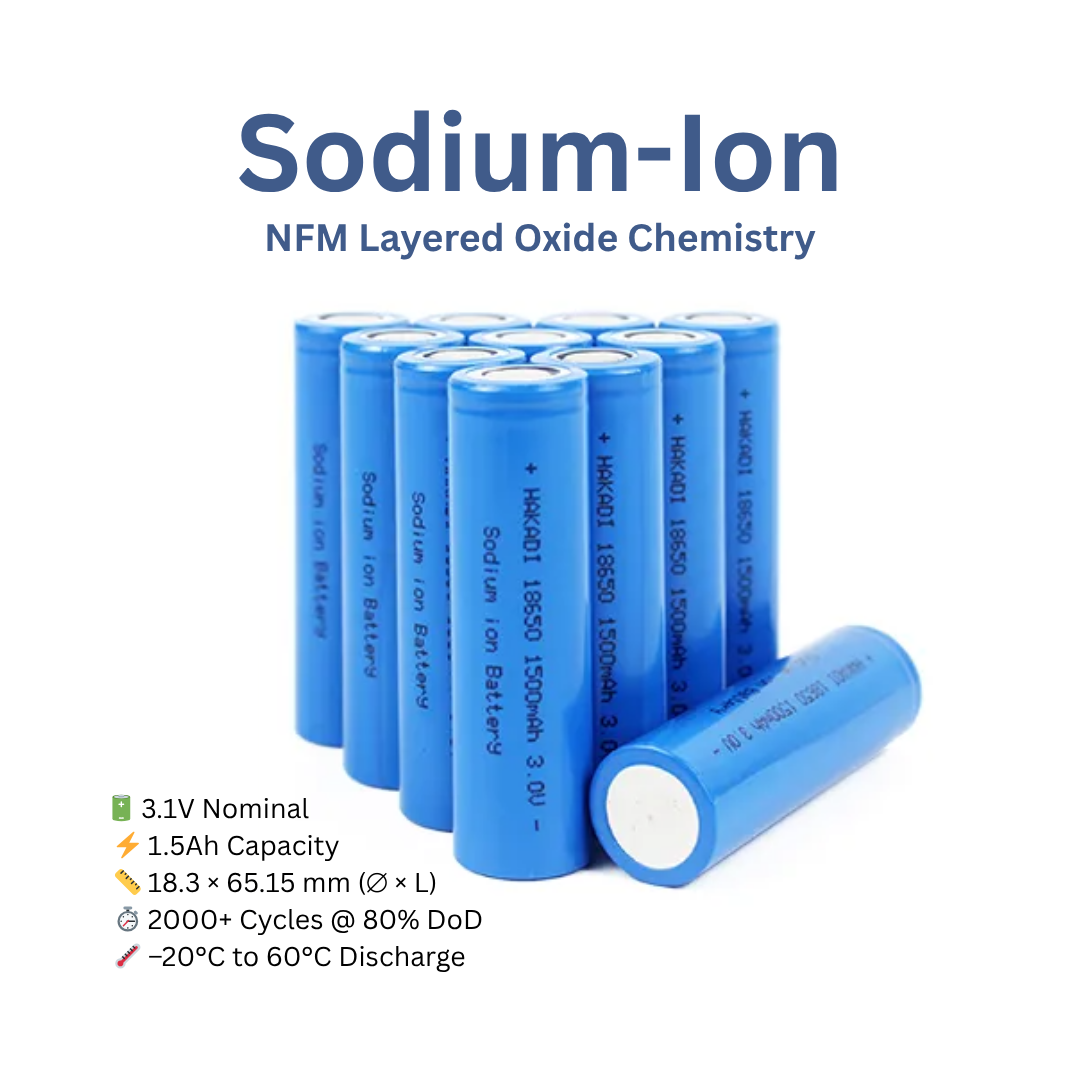
| 1,500 mAh | 3.10V | 4.10V | 1.50V | ≥1,000 cycles | 3C |
Not sure which batch you have? Send us your order number and we will tell you.
Picked up a batch to build a small backup pack and ran capacity tests on each one. All cells came in within 2% of rated capacity and IR was tight across the lot. Voltage range is different from LFP so you have to plan your BMS settings carefully, but for cold-weather and abuse tolerance these are unbeatable. Will be ordering more.
I wanted to try Sodium type batteries and the seller was helpful in sharing voltage limits and BMS recommendations. Cool store!


Picked up a batch to build a small backup pack and ran capacity tests on each one. All cells came in within 2% of rated capacity and IR was tight across the lot. Voltage range is different from LFP so you have to plan your BMS settings carefully, but for cold-weather and abuse tolerance these are unbeatable. Will be ordering more.
I wanted to try Sodium type batteries and the seller was helpful in sharing voltage limits and BMS recommendations. Cool store!