


OGS-Drop
160Ah Sodium-Ion Prismatic Cell (NFPP) 3.0V, 6,000+ Cycles, Ships Direct from Factory
160Ah Sodium-Ion Prismatic Cell (NFPP) 3.0V, 6,000+ Cycles, Ships Direct from Factory
Couldn't load pickup availability
Share
160Ah NFPP Sodium-Ion Prismatic Cell: Lithium-Free, Cold-Tolerant Storage for Serious Banks
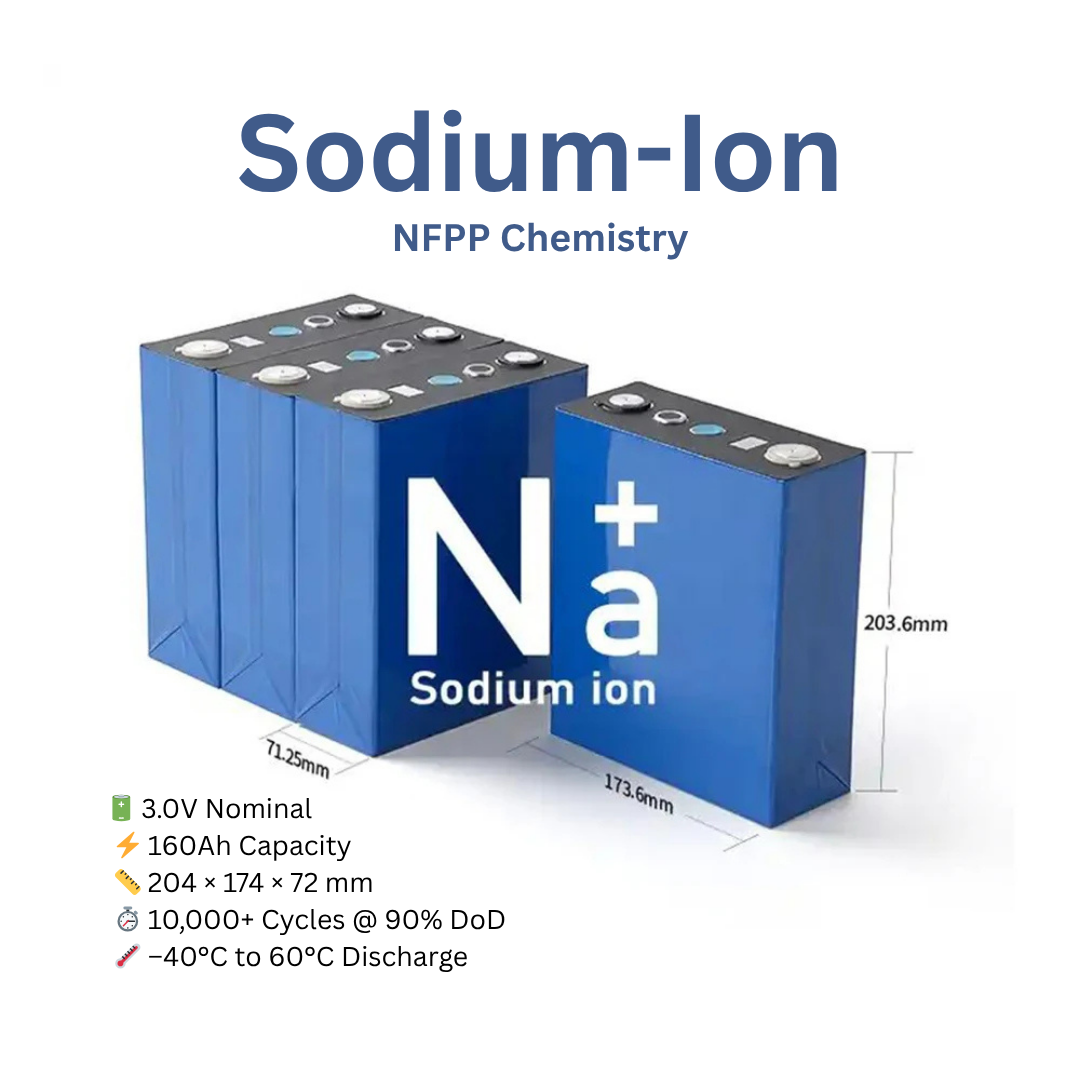
This 160Ah sodium-ion prismatic cell is built for stationary storage. It uses sodium instead of lithium, cobalt, or nickel, and it's designed around safety, long cycle life, and cold-weather discharge. It fits off-grid solar banks, backup power, and BESS racks: any build where uptime and service life matter more than watt-hours per liter.
It also shares the footprint of the 280Ah to 314Ah LFP cells most DIY builders already know: same 71.7 mm thickness and 173.7 mm width, 2.6 mm taller. Fixtures, busbar spacing, and our compression plates carry over.
What you get when you buy cells from OGS
We've spent years building relationships with the cell factories we buy from, ordering from them again and again and checking what shows up. We only list cells from reputable manufacturers we trust, so you're not gambling on an unknown seller or a listing that doesn't match the cell in the box.
- Vetted suppliers: these cells come from a sodium-ion factory we buy from directly, the same way we source our 18650 cells.
- Specs we've actually read: we go through the full datasheet for every cell we sell and put the numbers that matter (charge limit, low cut-off, temperature limits, BMS settings) on this page.
- Your batch, confirmed: we send you the manufacturer, model, and datasheet for your cells before they ship. If it isn't what you expected, we cancel and refund before anything ships.
- One point of contact: if a cell arrives damaged or out of spec, you deal with us, not a factory sales rep on the other side of the world.
- Freight, duties, and customs handled: the price includes delivery to the US mainland. No surprise tariff bills.
- Lead time: large prismatic cells ship by sea, typically 6 to 8 weeks to your door. Need them sooner? Email us about air freight.
📐 Cell Specifications
- Model: PORFFOR SIB-P71173208-160Ah
- Chemistry: NFPP (sodium iron pyrophosphate polyanion cathode), hard carbon anode
- Nominal Voltage: 3.0 V
- Nominal Capacity: 160 Ah (≈480 Wh, ~114 Wh/kg)
- Charge Voltage (max): 3.8 V
- Discharge Cut-off Voltage: 1.5 V (see the warranty note below before you set your BMS)
- Standard Charge / Discharge Rate: 0.5C (80 A)
- Max Charge Current: 1C (160 A)
- Max Continuous Discharge: 2C (320 A)
- Pulse Discharge: 3C (480 A) for 30 s at 25 °C, 100% SOC
- Internal Resistance: ≤0.65 mΩ (AC 1 kHz)
- Cycle Life: ≥6,000 cycles to 80% · ≥10,000 cycles to 70% (0.5C/0.5C, 3.8 to 1.5 V, 25 °C)
- Charge Temperature: 0 °C to 55 °C (no charging below 0 °C)
- Discharge Temperature: −40 °C to 60 °C
- Storage: 15 °C to 35 °C at 1.5 to 3.0 V
- Weight: 4.2 ±0.2 kg
- Dimensions: 207.2 × 173.7 × 71.7 mm (H × W × T, thickness under 200 kgf preload)
- Terminals: Aluminum posts, M6 threaded studs
⚡ Performance & Thermal Behavior
- Low-temp discharge: Discharges down to −40 °C. Delivers ≥80% of rated capacity at −20 °C (1C discharge to 1.5 V).
- High-temp discharge: After soaking at 55 °C, delivers ≥96% of rated capacity (1C discharge to 1.5 V).
- Charge retention: ≥90% of capacity after 30 days at 25 °C, with ≥95% recovery after recharge.
- Compression: Tested under 300 kgf (about 2,900 N) of preload, the same range modern LFP prismatics want. Build it clamped, not loose.
Read the cold-weather fine print. This cell discharges in deep cold far better than LFP, but it does not charge below 0 °C, same as LFP. A bank in an unheated shed will carry your loads on a −20 °C morning, but it won't accept solar charge until the cells warm above freezing. Plan for mild heat or a BMS that holds off charging until the cells are above 0 °C.
🔒 Safety & Abuse Test Results
Per the manufacturer's specification, the SIB-P71173208-160Ah passed these abuse tests with no fire and no explosion:
- Overcharge: forced to 6.0 V at 1C.
- Short circuit: external short ≤5 mΩ for 10 min.
- Crush: pressed to 200 kN or 30% deformation.
- Heat: 130 °C held for 30 min, no leakage.
- Drop: 1.5 m onto concrete.
- Seawater immersion: fully submerged in 3.5% NaCl for 2 hours.
- Thermal cycling: −40 °C to 85 °C, 5 cycles.
Translation: the phosphate cathode holds its oxygen tightly, which makes this chemistry far harder to push into thermal runaway than typical lithium-ion.
🧪 NFPP vs Layered Oxide: Which Sodium-Ion Chemistry Is This?
This is an NFPP polyanion sodium-ion cell (sodium iron pyrophosphate cathode, hard carbon anode), not a layered oxide cell and not Prussian Blue. The 3.0 V nominal and 3.8 V charge ceiling are the NFPP signature.
| Characteristic | Layered Oxide | NFPP (Polyanion) |
|---|---|---|
| Voltage Window | ~1.5 to 4.1 V | 1.5 to 3.8 V |
| Energy Density | Higher (up to ~160 Wh/kg) | Lower (~80 to 115 Wh/kg) |
| Cycle Life | ~1,000 to 3,000 cycles | 6,000+ cycles on this cell |
| Thermal Stability | Moderate to high | Very high in abuse tests |
| Best Use Case | Mobility, weight-sensitive builds | Stationary ESS, off-grid solar, backup power, telecom racks |
More in our NFPP cell review and NFPP vs NFM.
🔋 Pack Sizing: 12V, 24V, and 48V Banks
| Target Pack | Series | Nominal | Full Charge (3.8 V/cell) | Energy | Order |
|---|---|---|---|---|---|
| 12V | 4S | 12.0 V | 15.2 V | 1.9 kWh | 4-pack |
| 24V | 8S | 24.0 V | 30.4 V | 3.8 kWh | 2 x 4-pack |
| 48V | 16S | 48.0 V | 60.8 V | 7.7 kWh | 20-pack (4 spares) |
Check your inverter before you pick a series count. Sodium's voltage window is wider than LFP's. A 16S pack charged to 3.8 V per cell reaches 60.8 V, above the 58 to 60 V battery limit of many 48V inverters. Most of those inverters also shut off around 40 V, which is 2.5 V per cell at 16S. Two common fixes: charge a 16S pack to about 3.6 V per cell (57.6 V) and give up a little capacity at the top, or run 15S (45 V nominal, 57 V full). Match the pack to your inverter's battery input window, not to the nameplate voltage.
🛠 Integration Notes (Read Before Building a Pack)
- BMS required with balancing. The manufacturer requires a BMS that manages over and under voltage, current, temperature, and active equalization between cells. A stock lithium BMS won't work out of the box; use a sodium-specific or programmable unit (Daly, JK, ANT) that accepts your cut-offs.
- Charge limit: 3.8 V per cell, never higher. Do not use an LFP or lithium-ion charger profile without reconfiguring it.
- Low cut-off: set it at 1.8 V per cell or higher. The spec lists 1.5 V as the cut-off, but its warranty section says cells taken below 1.8 V can be permanently damaged and lose warranty coverage. Treat 1.8 V as your floor and let the inverter stop you well before it.
- No charging below 0 °C. Your BMS needs a low-temperature charge cut-off.
- Compression: clamp the cells at roughly 200 to 300 kgf. Our compression plates fit this footprint.
- Thermal design and sealing: your enclosure needs to manage heat, avoid hot spots, and keep out dust and moisture. Corrosion from water ingress is not covered.
- Don't mix cells: never mix part numbers, revisions, or batches in one series string. Buy every cell for a bank, including spares, in one order.
- Storage: cells arrive at 2.5 to 3.0 V. If they'll sit longer than 3 months before you build, store them at 15 to 35 °C, check voltages every 3 months, and recharge any cell near 1.5 V.
📋 Warranty
- Manufacturer warranty: 12 months from the manufacture date printed on the cell. Cells that don't meet the specification in that window are replaced by the factory.
- Keep your BMS logs. The manufacturer requires BMS monitoring records to evaluate any claim. Pick a BMS that logs cell voltages and temperatures, and keep the data.
- Not covered: over-discharge below 1.8 V, charging outside 0 to 55 °C, overcharge above 3.8 V, physical damage, and moisture damage.
- Arrived damaged? Photograph the packaging and cells before you unpack further and contact us within 48 hours of delivery.
View datasheet (PDF)
Built a 16s pack with these for off-grid storage at the cabin. Cells arrived well packed and at storage voltage. Top balanced them with a bench supply and they took the charge perfectly. Capacity tested at a full 162Ah on average. NFPP chemistry handles cold mornings way better than my old LFP bank.


Built a 16s pack with these for off-grid storage at the cabin. Cells arrived well packed and at storage voltage. Top balanced them with a bench supply and they took the charge perfectly. Capacity tested at a full 162Ah on average. NFPP chemistry handles cold mornings way better than my old LFP bank.