


Product overview
LMFP · 21700 · Lithium manganese iron phosphate · Special order
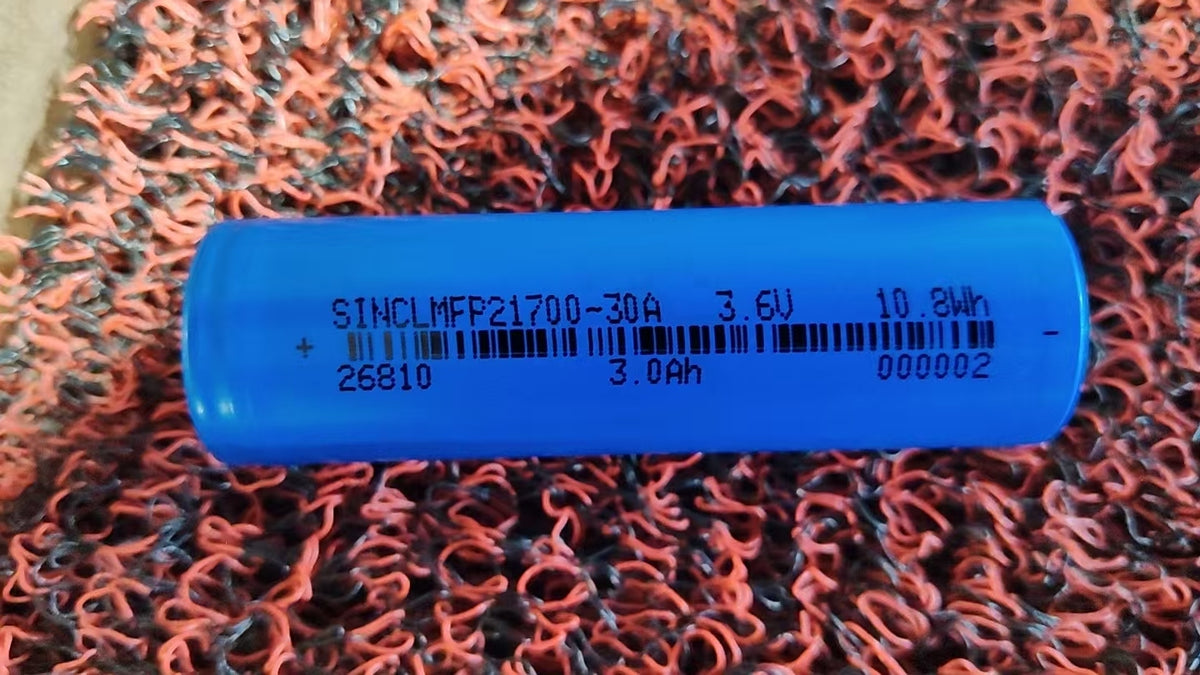
LMFP (lithium manganese iron phosphate) 21700 battery cells, 3.6 V 3000 mAh, sold in 4-packs for DIY packs and chemistry testing. Each cell stores 10.8 Wh, is rated 3C (9 A) continuous and at least 1,000 full cycles. LMFP charges to 4.2 V per cell, well above LFP's 3.65 V, so it needs LMFP charger and BMS settings, not LFP ones; the setpoints for 4S, 7S and 14S packs are below. This is a special order: we order the cells from the factory when you order, so allow 4 to 6 weeks.
- OGS part
- LMFP-21700-04
- Capacity
- 3.0 Ahrated, 0.5C [2]
- Nominal
- 3.6 Vvs 3.2 V for LFP [2]
- Energy
- 10.8 Whper cell [3]
- Continuous
- 9 A3C [2]
- Cycle life
- ≥ 1,000full cycles to 80 % [2]
- Chemistry
- LMFPLiMnxFe1-xPO4 cathode [1][4]
- Format
- 21700Ø21.9 × 72.2 mm max [2]
- Build
- Bare cell · Unprotected · Grade A, factory barcode [1] · UN38.3 tested [3]
Special order: we order these from the factory when you order. Specs below are from the cell maker's datasheet [2]; our own bench test will be added once our sample cells arrive. Photos show the maker's cells; our own photos will replace them.
Dimensions mm, drawn to scale
Mass 73 max g
Maximum dimensions and mass from the maker's datasheet [2]. The safety data sheet lists 65 g [4]. We will add our own measurements.
Why this cell
More volts per cell
3.6 Vnominal, vs 3.2 V for LFP [2]
Manganese in the phosphate cathode raises the cell voltage. At the same capacity that is 12.5 % more energy than an LFP cell.
Standard 21700 size
Ø21.9 mm× 72.2 mm max [2]
Fits common 21700 holders and spacers, and builds with the same nickel strip and spot welding as any 21700 pack.
Maker-tested capacity
3.3 Ahaverage of 5 cells at 0.5C [5]
The maker's lab data shows 3.29 to 3.38 Ah per cell against a 3.0 Ah rating. We will publish our own bench test when our sample cells arrive.
Common applications
- Lab and university bench testing of LMFP chemistry
- Side-by-side comparisons with LFP and sodium-ion cells
- E-bike and scooter packs, the format's main market [1]
- Small prototype packs for robotics and portable power
Specifications every value names its source
| Attribute | Value | Condition and source |
|---|---|---|
| Ratedfrom the cell maker's datasheet [2] unless marked | ||
| Chemistry | Lithium manganese iron phosphate (LMFP) | cathode named in the maker's safety data sheet [4] and in writing [1]. Mn ratio: requested |
| Capacity, rated | 3.0 Ah | 0.5C discharge to 2.5 V at 25 ± 2 °C [2] |
| Capacity, minimum | 3.0 Ah | 0.5C [2] |
| Nominal voltage | 3.6 V | [2] |
| Energy, rated | 10.8 Wh | [3] |
| Max charge voltage | 4.2 V | CC-CV [2]. Absolute maximum not stated; requested |
| Discharge cut-off | 2.5 V | [2] |
| Standard charge | 0.5C (1.5 A) to 4.2 V | then hold 4.2 V until current falls to 0.02C (60 mA) [2] |
| Max continuous charge | 1C (3.0 A) | at 20–35 °C [2] |
| Max continuous discharge | 3C (9.0 A) | [2] |
| Internal resistance | ≤ 25 mΩ | AC impedance, 1 kHz [2] |
| Cycle life | ≥ 1,000 cycles | 0.5C charge to 4.2 V, 1C discharge to 2.5 V (full depth), 25 °C, until capacity falls to 80 % [2] |
| Charge temperature | 0 to 45 °C | full 1C only from 20 to 35 °C [2] |
| Discharge temperature | −20 to 60 °C | [2] |
| Storage | 25–45 % charge | −20 to 25 °C for up to 1 year (35 °C up to 3 months, 45 °C up to 1 month); recharge every 3 months [2] |
| Transport certification | UN38.3, passed | UN Manual of Tests and Criteria Rev. 8, report 2026-08-19 [3] |
| Grade | Grade A, new production | each cell carries its factory barcode [1] |
| Performanceminimum capacity the cell must deliver, from the maker's test criteria [2], plus the maker's own lab data [5] | ||
| Capacity by discharge rate | 0.2C ≥ 100 % · 1C ≥ 95 % · 2C ≥ 85 % · 3C ≥ 80 % | of initial capacity, discharged to 2.5 V [2] |
| Capacity by temperature | −20 °C ≥ 60 % · 55 °C ≥ 95 % | 0.5C discharge to 2.5 V [2] |
| Self-discharge | ≥ 90 % left after 28 days | full charge at room temperature; ≥ 95 % recovers on recharge [2] |
| Maker's lab test, 5 cells | 3.29–3.38 Ah · 11.9–12.2 Wh | 0.5C charge to 4.2 V, 0.5C discharge to 2.5 V; average discharge voltage 3.59–3.62 V [5] |
| Calculatedarithmetic on [2] and [3], shown so you can check it | ||
| Energy per cell | 10.8 Wh | 3.0 Ah × 3.6 V |
| Energy density, volumetric | ≈ 397 Wh/L | 10.8 Wh ÷ 27.2 cm³ (Ø21.9 × 72.2 mm max [2]) |
| Energy density, gravimetric | ≈ 148 Wh/kg | 10.8 Wh ÷ 73 g max [2]; ≈ 166 Wh/kg at the 65 g in the safety data sheet [4] |
| Standard discharge | 0.5C (1.5 A) | the rate behind the 3.0 Ah rating [2] |
| Energy vs LFP at the same capacity | +12.5 % | 3.6 V ÷ 3.2 V |
| 4S pack (one 4-pack) | 14.4 V · 3.0 Ah · 43 Wh | 4 × 3.6 V, 4 × 10.8 Wh; charges to 16.8 V |
| Usable capacity, typical inverter window | Not tested yet | from our bench test of the sample cells |
BMS and charger setpoints
Per-cell values from the maker's datasheet [2], multiplied out. 14S suits a 48 V system (58.8 V full); 16S charges to 67.2 V, above what most 48 V inverters accept. Check your inverter's limits.
| Setpoint | Per cell | 4S | 7S | 14S |
|---|---|---|---|---|
| Max charge voltage (CV)charger setpoint; end charge at 0.02C (60 mA) [2]. The maker gives no higher absolute limit, so do not set the BMS over-voltage much above this | 4.2 V | 16.8 V | 29.4 V | 58.8 V |
| Nominal[2] | 3.6 V | 14.4 V | 25.2 V | 50.4 V |
| Discharge cut-off / BMS under-voltagedatasheet cut-off [2]. Set your inverter's low cut-off above this; we will suggest a value from our bench test | 2.5 V | 10.0 V | 17.5 V | 35.0 V |
Batch history
Special order. Each order is placed with the factory when you order.
| Batch | Capacity | Nominal | Continuous | Status |
|---|---|---|---|---|
| A | 3.0 Ah | 3.6 V | 3C | special order |
Works with this cell parts we sell that are set up for it
Testcheck cells before you build
 EBC-A20 capacity tester$139.00
 Internal resistance tester$69.99
Questions builders ask
Is LMFP the same as LFP?
No. LMFP adds manganese to the lithium iron phosphate cathode. That raises the nominal voltage from 3.2 V to 3.6 V per cell, so it holds more energy at the same capacity.
Can I use an LFP charger or BMS?
No. These cells charge to 4.2 V per cell and stop discharging at 2.5 V, so LFP limits do not fit. Set the charger to 4.2 V per cell (16.8 V for 4S, 58.8 V for 14S). The full table is on this page.
Can I charge them in the cold?
Only from 0 to 45 °C, never below freezing. Full 1C charging is rated from 20 to 35 °C. They can discharge from −20 to 60 °C.
When do these ship?
They are a special order. We order them from the factory when you order, so allow 4 to 6 weeks. We will email you if anything changes.
Sources
- [1] Written statements from the cell maker, 2026-11-07: LMFP chemistry, made in its own factory, Grade A, new production, factory barcode on each cell; the 21700 is mainly used in e-bike packs.
- [2] Cell maker's datasheet (specification of product), LMFP21700-30A, revision A0, issued 2025-11-04.
- [3] UN38.3 test report for the LMFP21700-30A cell, independent test lab, issued 2026-08-19: 3.6 V, 3.0 Ah, 10.8 Wh; passed.
- [4] Cell maker's safety data sheet for the LMFP 21700 3.6 V 3000 mAh cell: lithium manganese iron phosphate cathode, 65.0 g, 21.9 × 72.2 mm.
- [5] Cell maker's lab data, 5 cells: 0.5C charge to 4.2 V and 0.5C discharge to 2.5 V. Test date not stated.